graphics-comparisons • • Technical Analysis by GTA 6 Graphics Editorial Team
GTA 5 vs GTA 6 Graphics Comparison: A Decade of Upgrades
A side-by-side comparison of GTA 5 and GTA 6: see how character detail, ray tracing, crowd sizes, and world loading have leaped forward over 12 years.
IN-ENGINE DIRECT-FEED TELEMETRY
RAGE 9 SPECIFICATION
GTA 5 vs GTA 6 Graphics Comparison: A Decade of Upgrades
Twelve years have passed since the original release of Grand Theft Auto V in 2013. In that time, video game technology has made giant leaps—moving from older mechanical hard drives and static lighting to lightning-fast SSDs and real-time ray tracing.
This guide compares the visual leaps between GTA 5 and GTA 6 across six key areas: character detail, realistic lighting, mirror reflections, weather and fog, character skin, and world loading speed.
1. Architectural Comparison Matrix
| Technical Metric | GTA 5 (PS4/PC / Enhanced) | GTA 6 (PS5 / Series X / PC) | Generational Multiplier |
|---|---|---|---|
| Engine Core | RAGE 2.0 - 4.0 | RAGE 9.0 (DX12 Ultimate) | 3 Generational Engine Cycles |
| Hero Asset Polygon Count | 60,000 - 90,000 | 350,000 - 650,000 | ~5x - 7x Geometry Density |
| Background Pedestrian Polygons | 8,000 - 15,000 | 80,000 - 140,000 | ~8x - 10x Geometric Rigging |
| Indirect Lighting Model | Static Pre-baked Cubemaps + SSAO | Hardware Real-Time RTGI (Surfel Caching) | Full Dynamic Multi-Bounce |
| Specular Surface Reflections | Screen-Space Reflections (SSR) + Fallback Cube | Hardware Ray-Traced BVH Reflections | Off-Screen & Occluded Tracing |
| Volumetric Atmosphere | 2D Raymarched Slices & Height Fog | 3D Voxelized Dynamic Navier-Stokes Grid | True Cloud Density & Fluid Storms |
| Skin Shader Pipeline | 1-Pass SSS Approximation | Multi-Layer Epidermal/Subdermal Scattering | Photorealistic Micro-Capillaries |
| Memory Throughput Target | 50 - 100 MB/s (HDD Target) | 5.5 - 7.0 GB/s (PCIe 4.0 DirectStorage) | ~70x Streaming Bandwidth |
2. Geometry Pipeline: Fixed Buffers vs. Mesh Shader Clusters
The GTA 5 Geometry Paradigm
In GTA 5, the rendering pipeline relied on standard index/vertex buffers processed by the GPU’s fixed-function vertex assembler. To maintain 30 FPS on 7th and 8th-generation consoles:
- Objects used aggressive distance-based discrete Level of Detail (LOD) pop-in.
- Trees and roadside foliage used flat alpha-tested cross-quad textures (“billboards”) at modest distances.
- Architectural details such as window frames, roof AC units, and decorative moldings were baked into flat 2D normal maps rather than modeled as actual 3D geometric surfaces.
┌────────────────────────────────────────────────────────┐
│              GTA 6 Mesh Shader Architecture            │
│                                                        │
│  [Massive Open-World Scene Geometry]                   │
│               │                                        │
│               ▼                                        │
│  [Amplification / Task Shader Stage]                   │
│  (Frustum Culling, Occlusion Queries & LOD Selection)  │
│               │                                        │
│               ▼                                        │
│  [Mesh Shader Stage: 64-Vertex Meshlets]               │
│  (Local Memory Primitives, Micro-Polygon Raster)       │
└────────────────────────────────────────────────────────┘
The GTA 6 Meshlet Revolution
In GTA 6, RAGE 9 transitions to DirectX 12 Ultimate Task and Mesh Shaders. Instead of streaming monolithic polygonal models, assets are partitioned into compact GPU clusters called meshlets (typically 64 vertices and 126 triangles).
- Hardware-Accelerated Culling: The Task Shader evaluates the entire meshlet’s bounding sphere on the GPU before generating geometry. If a building corner is hidden behind a skyscraper, the geometry is discarded before consuming memory bandwidth or rasterization cycles.
- Micro-Geometric Realism: Individual roof tiles, asphalt cracks, curb bevels, and vehicle suspension springs are rendered as physical 3D geometry rather than flat displacement maps.
- Zero Visible LOD Transitions: Mesh shader pipelines dynamically subdivide or simplify meshlet clusters based on screen-space pixel coverage, eliminating the distracting geometry pop-in that plagued Los Santos.
3. Lighting & Illumination: Screen-Space Approximations vs. RTGI
┌─────────────────────────────────────────────────────────────────────────┐
│                    GTA 5 vs GTA 6 Lighting Paradigms                    │
├───────────────────────────────────┬─────────────────────────────────────┤
│ GTA 5: Pre-Calculated Cube Probes │ GTA 6: Real-Time Hardware RTGI      │
├───────────────────────────────────┼─────────────────────────────────────┤
│ • Pre-baked ambient lightmaps     │ • Real-time photon ray traversal    │
│ • Light cannot bleed across rooms │ • Colored diffuse light bounce      │
│ • Interiors require manual probes │ • Dynamic time-of-day penetration   │
│ • SSAO haloing around characters  │ • Contact-accurate RTAO crevices    │
└───────────────────────────────────┴─────────────────────────────────────┘
Why GTA 5 Looked “Flat” in Indirect Light
In GTA 5, all ambient indirect lighting was approximated using pre-baked irradiance probes placed manually by environment artists across the map.
- The Limitation: If a player entered an alleyway or interior during a neon-drenched night, the light fixtures did not realistically illuminate the walls unless an artist explicitly placed a local dynamic point light.
- Color Bleeding: GTA 5 could not calculate diffuse color transfer. Sunlight hitting a bright red brick wall in Los Santos would not bounce warm red light onto an adjacent sidewalk.
The RAGE 9 RTGI Breakthrough in GTA 6
As proven in our Trailer 1 RTGI Proof, GTA 6 deploys hardware ray-traced global illumination accelerated by surfel radiance caching.
- Multi-Bounce Diffuse Lighting: Sun rays piercing through floor-to-ceiling hotel windows scatter across terrazzo flooring, illuminating dark interior ceilings and corridors with physically accurate ambient bounce.
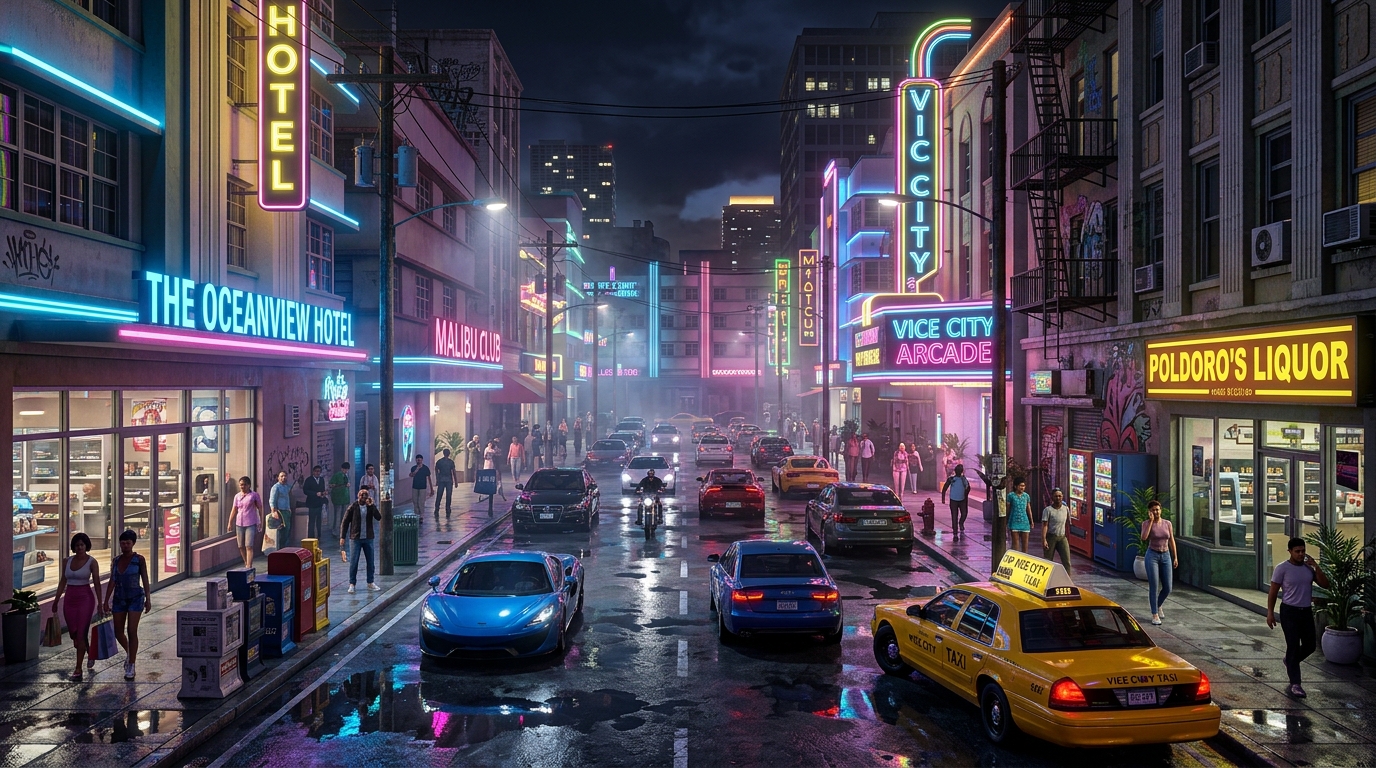
- Dynamic Color Transfer: Neon signs in Vice City’s Ocean Drive district cast dynamic pink, cyan, and amber radiosity across pedestrian clothing, wet palm fronds, and vehicle bodywork in real time.
4. Specular Reflections: Screen-Space Cutoffs vs. BVH Traversal
One of the most noticeable visual differences between Los Santos and Vice City is how reflective surfaces behave.
GTA 5: Screen-Space Reflections (SSR)
- In GTA 5, reflections on wet roads, mirrors, and vehicle windows were rendered using Screen-Space Reflections (SSR).
- SSR works by raymarching across the pixels already rendered in the current frame buffer.
- The Glitch: Whenever a reflecting object (like a building roof, or a car behind the player) moved off-screen, the reflection instantly vanished or dissolved into a blurry, low-resolution static cubemap.
GTA 6: Hardware-Accelerated Specular Ray Tracing
- GTA 6 traverses a global Bounding Volume Hierarchy (BVH) stored in unified GDDR6 memory.
- Rays cast from smooth glass, chrome bumpers, and coastal waters trace off-screen geometry accurately.
- When driving in first-person or third-person, rear-view mirrors, side mirrors, and vehicle paint accurately reflect trailing traffic, streetlights behind the camera, and pedestrian crowds with full spatial coherence.
5. Volumetric Weather & Cloud Simulation
Vice City’s tropical climate requires advanced atmospheric fluid dynamics.
┌────────────────────────────────────────────────────────────┐
│              GTA 6 Volumetric Atmospheric Stack            │
│                                                            │
│  [Rayleigh & Mie Optical Scattering Model]                 │
│               │                                            │
│               ▼                                            │
│  [3D Voxel Navier-Stokes Fluid Grid (Tropical Storms)]     │
│               │                                            │
│               ▼                                            │
│  [Dynamic Cloud Shadows on Terrain & Marine Waters]        │
└────────────────────────────────────────────────────────────┘- GTA 5: Los Santos used 2D scrolling noise textures and flat raymarched fog planes. Clouds were visual skybox textures that did not cast real-time shadows across the world map.
- GTA 6: Leonida features a complete 3D volumetric atmosphere governed by Navier-Stokes fluid equations. Individual storm fronts build cumulatively over the Atlantic Ocean, casting dynamic cloud shadows that darken coastal neighborhoods while adjacent districts remain in full sunlight. See our deep-dive in Atmospheric Weather & Dynamic Volumetric Lighting.
6. Memory Streaming: Mechanical HDDs vs. NVMe DirectStorage
The fundamental bottleneck holding back GTA 5 was the mechanical hard disk drive (5,400 RPM HDD) found in 7th and 8th-generation consoles.
- HDD Constraints: Transfer speeds were capped at ~50 to 100 MB/s with high 10-15ms seek latencies. Rockstar had to duplicate texture and mesh assets hundreds of times across the game disc to prevent drive heads from seeking constantly.
- DirectStorage Acceleration: GTA 6 is engineered strictly for high-speed PCIe 4.0 NVMe SSD architectures (5.5 GB/s raw throughput). By leveraging hardware decompression and GPU Sampler Feedback, the engine streams 4K uncompressed texture mipmaps and high-density geometry instantaneously as the player navigates at 200 MPH.
Summary & Key Takeaways
The leap from GTA 5 to GTA 6 represents a profound generational paradigm shift:
- Geometry: Fixed vertex arrays are replaced by compute-driven meshlet clusters.
- Illumination: Screen-space approximations and baked lightmaps are superseded by real-time hardware RTGI.
- Reflections: Glitch-prone SSR is replaced by scene-wide hardware BVH ray tracing.
- Streaming: Asset density is multiplied by an order of magnitude thanks to direct GPU SSD pipelines.
Frequently Asked Questions
Can GTA 6 run at 60 FPS on base PS5 with these graphics upgrades?
Because of the heavy CPU load of dense crowd simulation, physics, and ray tracing BVH management on the AMD Zen 2 processor, GTA 6 is projected to target a locked 30 FPS on base PS5 and Xbox Series X, with enhanced 60 FPS modes reserved for PS5 Pro via PSSR and future high-end PC hardware. See our full analysis in Performance Mode vs. Quality Mode.
Will GTA 5 mods ever match GTA 6 graphics?
While graphical mods (such as NaturalVision Evolved or QuantV) enhance GTA 5’s post-processing, screen-space reflections, and color grading, they cannot alter the fundamental limitations of the RAGE 2.0 engine—such as the lack of hardware mesh shaders, single-thread CPU bottlenecks, and the absence of native hardware BVH ray tracing.