graphics-comparisons • • Technical Analysis by GTA 6 Graphics Editorial Team
GTA Graphics Evolution: From GTA 1 2D to GTA 6 Photorealism
Tracing 28 years of Grand Theft Auto graphics: from top-down 2D sprites to RenderWare 3D polygons, HD deferred shading, and RAGE 9 ray-traced visuals.
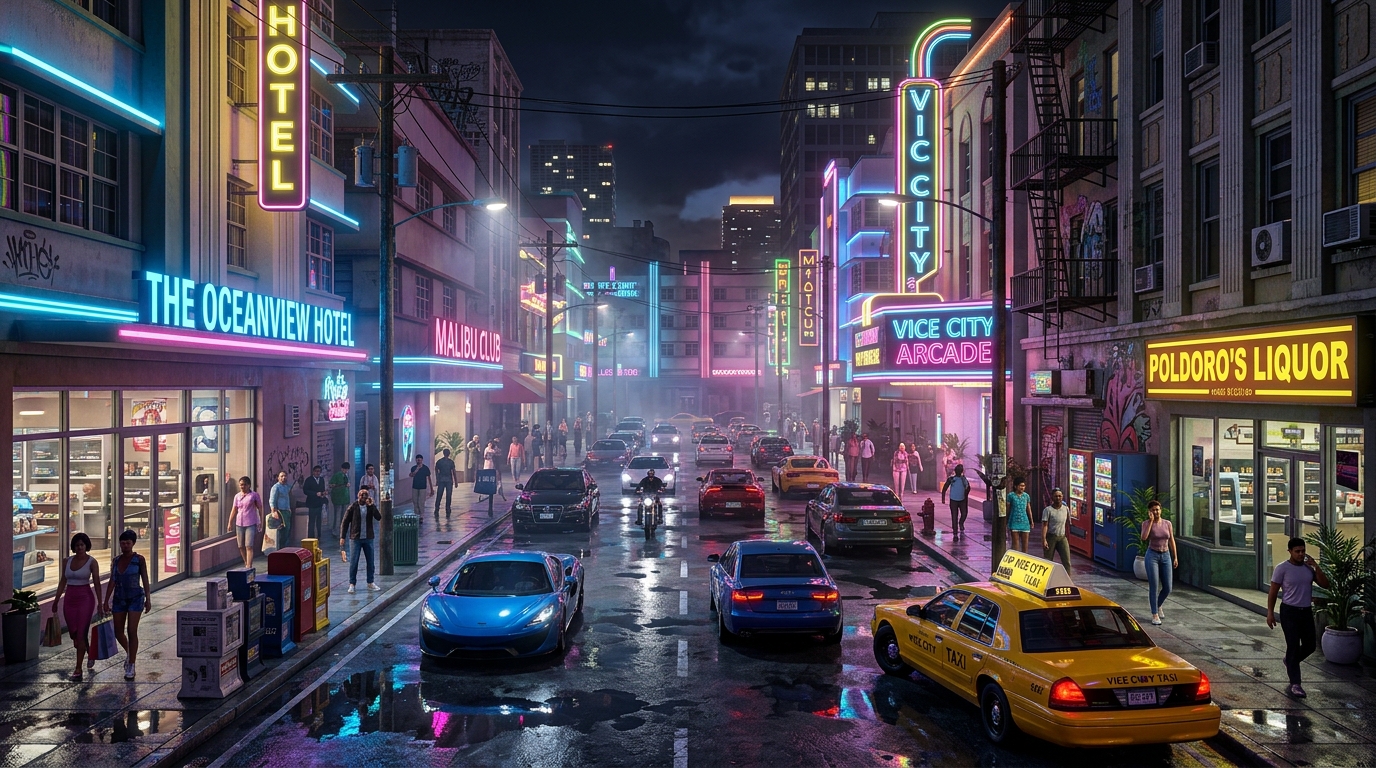
IN-ENGINE DIRECT-FEED TELEMETRY
RAGE 9 SPECIFICATION
GTA Graphics Evolution: From GTA 1 2D to GTA 6 Photorealism
Few software franchises illustrate the trajectory of computer graphics engineering more vividly than Grand Theft Auto. Across 28 years and multiple generational hardware shifts, Rockstar Games has transformed an experimental top-down MS-DOS prototype into a multi-threaded, path-traced simulation of modern urban civilization.
This historical analysis deconstructs the rendering architectures, memory paradigms, and mathematical illumination models powering each major generational leap in the franchise.
1. Generational Chronology & Silicon Constraints
┌────────────────────────────────────────────────────────────────────────────────────────┐
│                        28-Year Generational Architecture Matrix                        │
├───────────────┬──────┬─────────────────┬──────────────────────┬────────────────────────┤
│ Title         │ Year │ Silicon Target  │ Rendering Engine     │ Primary Illumination   │
├───────────────┼──────┼─────────────────┼──────────────────────┼────────────────────────┤
│ GTA 1 & 2     │ 1997 │ Pentium / PS1   │ Custom Software 2D   │ Unlit 8-bit Palettes   │
│ GTA III / VC  │ 2001 │ PS2 / Xbox / PC │ Criterion RenderWare │ Vertex Lighting        │
│ GTA: SA       │ 2004 │ PS2 / Xbox / PC │ RenderWare (Mod)     │ Dual-Palette Vertex AO │
│ GTA IV        │ 2008 │ PS3 / Xbox 360  │ RAGE 1.0 + Euphoria  │ Early Deferred Shading │
│ GTA V         │ 2013 │ PS3 / PS4 / PC  │ RAGE 2.0 (PBR 1.0)   │ Deferred + Cascaded SM │
│ GTA VI        │ 2025 │ PS5 / XSX / PC  │ RAGE 9.0 (Mesh/RT)   │ Real-Time RTGI + PSSR  │
└───────────────┴──────┴─────────────────┴──────────────────────┴────────────────────────┘
2. The 2D Era (1997–1999): Orthographic Tile Rendering
Software Rasterization & Flat Memory
In the original Grand Theft Auto (1997) and Grand Theft Auto 2 (1999), scenes were rendered from a fixed bird’s-eye perspective using 2D sprite tiles blitted onto a flat 2D frame buffer.
- Texture Allocation: Sprites were constrained to 8-bit indexed color palettes (256 colors) to fit within the 2 MB system RAM of the original Sony PlayStation and DOS VGA memory limits.
- Camera Projection: Dynamic zooming utilized simple software affine scaling of 2D tilemaps rather than real 3D perspective matrix calculations.
- Lighting Simulation: Illumination in GTA 2 was introduced via real-time software color tinting applied to tile vertices, simulating primitive headlights and streetlamps without dynamic shadow casting.
3. The 3D Era (2001–2004): Criterion RenderWare & Vertex Lighting
With the launch of Grand Theft Auto III on PlayStation 2 in 2001, Rockstar transitioned to full 3D geometry using Criterion’s RenderWare engine. This marked the franchise’s shift toward forward rendering pipelines.
Polygon Budgets and Texture Streaming
- Geometry Density: Character models in GTA III and Vice City averaged between 1,200 and 2,500 polygons. Claude and Tommy Vercetti featured rigid joint meshes with split limb segments rather than smooth continuous skin skinning.
- Memory Limits: The PS2’s 4 MB of eDRAM required aggressive texture downsampling. Most environmental textures were 64x64 or 128x128 uncompressed bitmaps.
- Vertex Lighting: Light was calculated exclusively at mesh vertices and interpolated across polygonal faces (Gouraud shading). Dynamic shadows did not exist; instead, dark circular alpha textures (“blob shadows”) were projected beneath vehicles and pedestrians.
- San Andreas Advancements: By 2004, GTA: San Andreas introduced a dual-palette vertex day/night transition system and rudimentary depth haze to mask the 500-meter draw distance ceiling.
4. The HD Transition (2008): RAGE 1.0, Euphoria & Deferred Shading
The release of Grand Theft Auto IV in 2008 on PlayStation 3 and Xbox 360 marked the debut of the Rockstar Advanced Game Engine (RAGE).
┌─────────────────────────────────────────────────────────────┐
│                 GTA IV Deferred G-Buffer Pass               │
│                                                             │
│  [Diffuse Albedo] ──► [World Normal] ──► [Specular / Gloss] │
│          │                   │                   │          │
│          └───────────────────┼───────────────────┘          │
│                              ▼                              │
│                   [Deferred Lighting Pass]                  │
│                     (Dynamic Spotlights)                    │
└─────────────────────────────────────────────────────────────┘
Architectural Breakthroughs in RAGE 1.0
- Deferred Lighting Pipeline: GTA IV was among the earliest open-world engines to adopt deferred lighting passes. This allowed Liberty City to render hundreds of dynamic vehicle headlights, lamp posts, and muzzle flashes simultaneously without multiplying geometry draw calls.
- Procedural Physics with NaturalMotion Euphoria: Rather than playing static ragdoll or baked death animations, CPU-driven neural network biomechanics calculated real-time muscle tensions, balance compensation, and physical mass transfer when NPCs were impacted by vehicles or gunfire.
- Screen-Space Ambient Occlusion (SSAO): RAGE introduced spatial screen-space depth sampling to create contact shadows around urban curbs and trash-strewn alleyways.
- Drawbacks: Heavy post-processing, aggressive motion blur, and sub-720p internal rendering resolutions (640p on PS3) were required to balance the intense CPU physics load against the 256 MB split memory architecture of 7th-generation consoles.
5. The Photorealism Push (2013–2022): GTA V & Physically Based Shading
Grand Theft Auto V launched at the very end of the PS3/Xbox 360 cycle before undergoing major remasters on 8th-gen (PS4/Xbox One), PC, and 9th-gen (PS5/Xbox Series X) hardware.
Rendering Pipeline Milestones
- Cascaded Shadow Maps (CSM): Sunlight projected crisp contact shadows close to the player, smoothly transitioning into lower-resolution shadow cascades over 2,000 meters.
- Physically Based Rendering (PBR): Materials transitioned from arbitrary specular/gloss values to energy-conserving microfacet BRDF models (metallic, roughness, normal maps). Vehicle paint featured clear-coat specular reflections.
- Volumetric Atmosphere: Dynamic atmospheric scattering replaced static skyboxes, accurately tinting mountains during Blaine County sunsets.
- Geometry Density: Main character models (Michael, Franklin, Trevor) exceeded 80,000 polygons, with high-frequency normal maps simulating clothing seams and facial pores.
6. The Next-Gen Horizon: RAGE 9 in Grand Theft Auto VI
With Grand Theft Auto VI, Rockstar has re-engineered RAGE from the ground up for DirectX 12 Ultimate, unified memory architectures, and dedicated hardware ray tracing silicon.
| Feature | GTA V (Enhanced 2022) | GTA VI (RAGE 9.0 2025) | Generational Uplift |
|---|---|---|---|
| Hero Character Polygon Budget | ~80,000 - 100,000 | 350,000 - 600,000 | 4.5x - 6x Geometry |
| Global Illumination | Baked Probes + SSAO | Hardware-Accelerated RTGI | Real-Time Dynamic Diffuse Bounce |
| Reflections | Screen-Space (SSR) + Planar | Hardware BVH Ray Traced | Off-Screen Continuous Reflections |
| Geometry Pipeline | Fixed Vertex Shaders | DX12 Task & Mesh Shaders | Cluster Meshlet Culling |
| Atmospheric Grids | 2D Slices / Raymarched Fog | Full 3D Voxel Volumetric Grids | Hurricane & Tropical Moisture Physics |
| Hair & Strand Simulation | Poly-strip Alpha Cards | Physics Strand Rigging + Subsurface | Individual Strand Light Transmission |
The Core Paradigm Shifts in GTA 6
- From Screen-Space Approximations to Hardware BVH: In GTA V, reflections disappeared whenever an object was occluded from the screen buffer. GTA VI traverses scene-wide hardware BVH trees, ensuring neon signs, vehicles, and pedestrians behind the camera reflect accurately across windshields and wet asphalt.
- From Baked Probes to Dynamic Surfel RTGI: Sunlight and neon light realistically bounce multiple times off pastel Vice City architecture, organically illuminating interior storefronts without pre-calculated lightmaps.
- From Texture Streaming Bottlenecks to DirectStorage: Unified SSD I/O pipelines eliminate the draw-distance pop-in of previous generations, enabling dense foliage and high-speed supercars without LOD stutter.
Frequently Asked Questions
Why did GTA III use Criterion RenderWare instead of a proprietary engine?
During the late 1990s and early 2000s, building an in-house cross-platform 3D engine was cost-prohibitive. Criterion Software’s RenderWare provided a robust, highly optimized 3D pipeline for the PlayStation 2 and PC, allowing Rockstar North to focus on game design, open-world streaming, and mission architecture.
When did Rockstar start using their own proprietary engine?
Rockstar established the Rockstar San Diego Technology Group to build the Rockstar Advanced Game Engine (RAGE), which debuted in 2006 with Rockstar Games Presents Table Tennis and made its open-world debut with Grand Theft Auto IV in 2008.
How does GTA 6 graphics technology compare to Unreal Engine 5?
While Unreal Engine 5 uses software/hardware Lumen and Nanite micro-polygon virtualization, Rockstar’s RAGE 9 is custom-tailored specifically for large-scale vehicular open worlds, multi-threaded CPU traffic simulation (see Take-Two NPC Patent), extreme streaming speeds, and seamless interior-to-exterior transitions without the traversal stutter common to general-purpose commercial engines.
Further Analysis
- For a direct technical comparison against GTA V, read GTA 5 vs. GTA 6 Graphics Leap.
- For the technical deep dive into Rockstar’s engine, consult RAGE 9 Engine Architecture.
- To see how real-time lighting is calculated, explore Hardware Ray Tracing in GTA 6.