consoles • • Technical Analysis by GTA 6 Graphics Editorial Team
PS5 Pro for GTA 6: Upgrade Decision & Performance Guide
A clear guide explaining how GTA 6 runs on PS5 Pro compared to standard PS5: AI 4K upscaling, extra ray tracing, and whether you should upgrade.
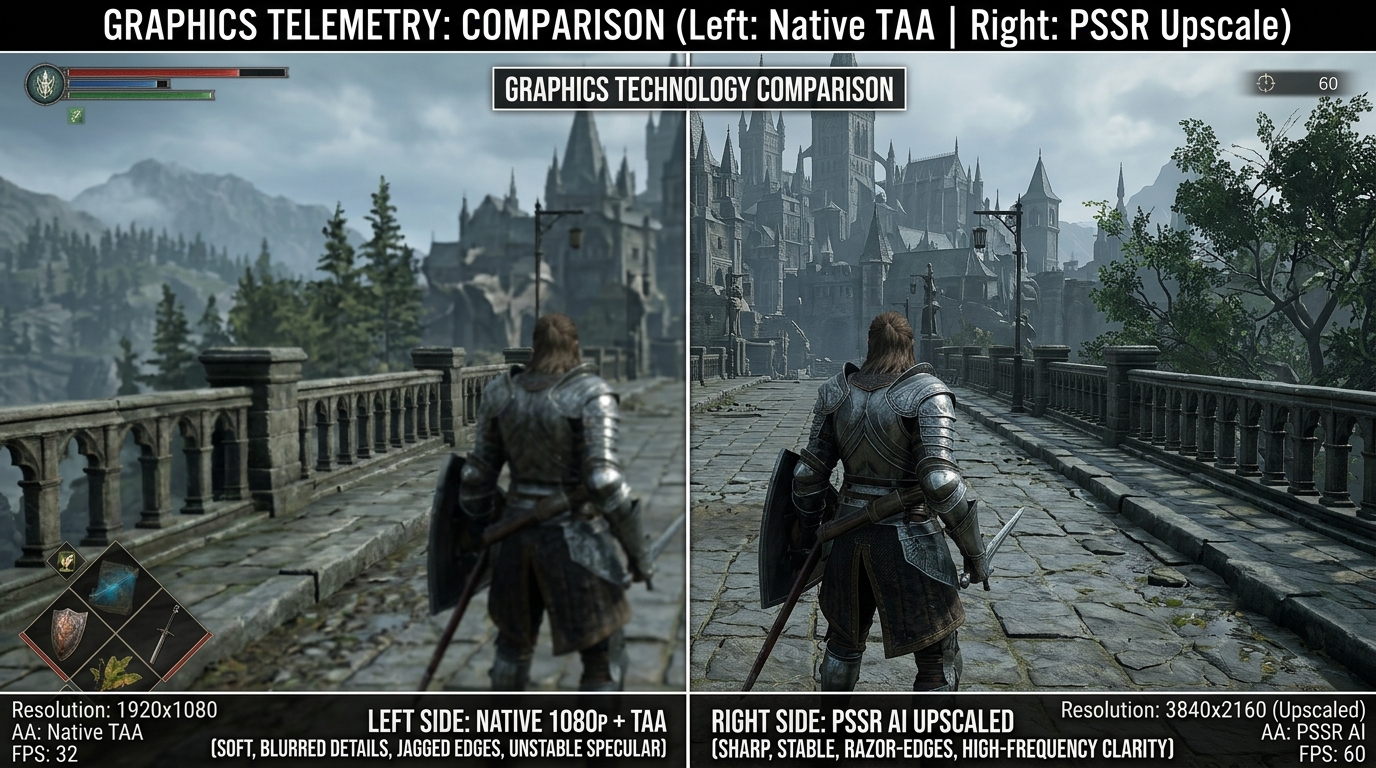
IN-ENGINE DIRECT-FEED TELEMETRY
RAGE 9 SPECIFICATION
PS5 Pro for GTA 6: Upgrade Decision & Performance Guide
The PlayStation 5 Pro promises a huge boost in graphics power, smarter AI upscaling, and much faster ray tracing. But it also comes with a premium price tag. If you’re planning to play Grand Theft Auto VI, is upgrading to the PS5 Pro truly worth your money?
While the PS5 Pro delivers noticeable visual enhancements, its main processor is almost identical to the standard PS5. Because open-world games rely heavily on processors for crowd simulation, that balance matters a lot.
[!IMPORTANT] Direct Recommendation: Is the PS5 Pro Upgrade Worth It for GTA 6?
- Worth it for: Players with a 120Hz/VRR 4K display who prioritize cleaner 4K image reconstruction (via Sony’s AI PSSR upscaling), richer ray-traced reflections on car clear-coats and puddles, and potential 40 FPS Balanced Mode support.
- Not worth it if: You are expecting a guaranteed, locked 60 FPS mode. The PS5 Pro shares the same Zen 2 CPU architecture with only a modest +10% clock boost, which does not bypass the CPU simulation bottleneck in dense Vice City traffic.
This guide breaks down exactly what the PS5 Pro does better, where its limits lie, and who will benefit most from upgrading.
1. Direct Hardware Specifications: PS5 vs. PS5 Pro
┌────────────────────────────────────────────────────────────────────────┐
│                   PS5 vs. PS5 Pro Silicon Architecture                 │
├────────────────────────┬──────────────────────┬────────────────────────┤
│ Specification          │ Base PlayStation 5   │ PlayStation 5 Pro      │
├────────────────────────┼──────────────────────┼────────────────────────┤
│ **GPU Architecture**   │ AMD RDNA 2 Custom    │ AMD RDNA 3/4 Hybrid    │
│ **Compute Units (CUs)**│ 36 CUs               │ 60 CUs (+67% CUs)      │
│ **GPU Clock Speed**    │ Up to 2.23 GHz       │ ~2.18 GHz              │
│ **FP32 Compute**       │ 10.28 TFLOPS         │ Up to 33.5 TFLOPS (Dual│
│ **Ray Tracing Silicon**│ RDNA 2 (1 Ray/CU)    │ RDNA 3/4 (2x-3x BVH)   │
│ **Neural / ML NPU**    │ None                 │ 300 TOPS Custom NPU    │
│ **CPU Architecture**   │ AMD Zen 2 (8c / 16t) │ AMD Zen 2 (8c / 16t)   │
│ **CPU Clock Speed**    │ 3.5 GHz (Variable)   │ 3.85 GHz High Freq (+10│
│ **Unified GDDR6 Memory**│ 16 GB @ 448 GB/s    │ 16 GB @ 576 GB/s (+28%)│
│ **Additional OS Memory**│ None                │ 2 GB DDR5 (Frees GDDR6)│
│ **Internal Storage**   │ 825 GB NVMe (5.5GB/s)│ 2 TB NVMe (5.5 GB/s)   │
└────────────────────────┴──────────────────────┴────────────────────────┘
2. The GPU Breakthrough: 67% More Compute & 3x Ray Tracing
┌─────────────────────────────────────────────────────────────┐
│                 GPU Rendering Capabilities                  │
├─────────────────────────────────────────────────────────────┤
│ Base PS5 : [36 RDNA 2 CUs]  ──► 10.3 TFLOPS                 │
│ PS5 Pro  : [60 Hybrid CUs]  ──► 33.5 TFLOPS + 3x RT Silicon │
└─────────────────────────────────────────────────────────────┘
The most dramatic advancement on the PS5 Pro resides in its expanded GPU:
- Rasterization Throughput: With 60 Compute Units on a larger die, raw pixel shading performance increases by approximately 45% to 50%. This enables the engine to push higher dynamic resolution scaling brackets and richer volumetric fog density.
- Advanced Ray Tracing Silicon: Borrowing architectural features from upcoming AMD RDNA architectures, the PS5 Pro includes dedicated hardware for double-rate ray-box testing and specialized traversal logic. In heavy ray tracing workloads—such as night scenes on Ocean Drive featuring real-time reflections and RTGI—the PS5 Pro achieves 2x to 3x the ray intersection throughput of the base console.
- Bandwidth & Memory Expansion: Memory bandwidth increases from 448 GB/s to 576 GB/s. Crucially, Sony added 2 GB of standard DDR5 RAM exclusively to handle the operating system, freeing up approximately 1.2 GB of ultra-fast GDDR6 memory directly for game developers to store higher-resolution 4K texture mipmaps and larger BVH acceleration structures.
3. The CPU Limitation: The Zen 2 Simulation Ceiling
While the GPU receives a generational leap, the CPU receives only a modest clock speed bump:
┌────────────────────────────────────────────────────────────┐
│                  CPU Clock Speed Comparison                │
├────────────────────────────────────────────────────────────┤
│ Base PS5 : 3.50 GHz (Zen 2 Architecture)                   │
│ PS5 Pro  : 3.85 GHz (High CPU Frequency Mode: +10.0%)      │
└────────────────────────────────────────────────────────────┘
Why CPU Matters for GTA 6
- Open-world simulations in the Rockstar Advanced Game Engine (RAGE 9) are exceptionally CPU-intensive.
- The CPU must calculate real-time crowd navigation (see Take-Two NPC Patent), vehicular traffic AI, vehicle suspension physics, procedural animation rigging, and audio propagation across thousands of concurrent entities.
- The 10% CPU clock increase provides an extra 1.0 to 1.5 milliseconds of frame time relief. While this stabilizes framerate drops in heavy CPU scenarios, it is not the 100% CPU uplift that would theoretically guarantee a 60 FPS mode in all open-world conditions.
4. Deep Dive: PlayStation Spectral Super Resolution (PSSR) Neural Pipeline
PlayStation Spectral Super Resolution (PSSR) is Sony’s proprietary AI upscaling technology, built exclusively for the PlayStation 5 Pro. For the first time on a home console, machine learning reconstructs a sharp 4K picture from lower internal resolutions without squandering GPU shader cycles.
┌────────────────────────────────────────────────────────────────────────┐
│                        PSSR Pipeline Data Flow                         │
│                                                                        │
│  [Internal Render Buffer (1080p - 1200p)] ──┐                          │
│  [High-Precision Motion Vectors]            ├──► [PS5 Pro Custom NPU]  │
│  [History Color Buffer (Previous Frames)]   │    (300 TOPS 8-bit ML)   │
│  [Depth & Exposure Buffers]                 │           │              │
│                                             └───┐       │              │
│                                                 ▼       ▼              │
│                       [Reconstructed 4K Ultra HD Frame (2160p)]        │
└────────────────────────────────────────────────────────────────────────┘
The Custom Neural Processing Silicon
Unlike the base PS5, which relies purely on standard AMD RDNA 2 compute units for all shader and post-processing tasks, the PS5 Pro incorporates a dedicated machine learning acceleration block:
- Inference Compute: Delivers approximately 300 TOPS (Tera-Operations Per Second) of 8-bit integer (INT8) matrix multiplication performance, as detailed by Sony Lead Architect Mark Cerny.
- Frame Execution Latency: PSSR processes an internal 1080p frame buffer into a full 4K (3840x2160) reconstructed output in approximately 1.8 to 2.2 milliseconds.
- Memory Footprint: Requires approximately 250 to 300 MB of GDDR6 memory allocated for historical color caches, motion vector tensors, and intermediate neural weights.
PSSR vs. AMD FSR 2/3 vs. NVIDIA DLSS 3.7
| Architectural Metric | AMD FSR 2.2 / 3.1 | PlayStation PSSR | NVIDIA DLSS 3.7 |
|---|---|---|---|
| Silicon Execution | Standard Asynchronous Compute | Dedicated Console NPU / Tensor Logic | Dedicated Tensor Cores (Ada/Blackwell) |
| Algorithm Type | Hand-Tuned Heuristics & Filters | Deep Convolutional Autoencoder | Deep Convolutional Autoencoder (AI) |
| Execution Cost (4K Output) | ~1.5 - 2.5 ms (Consumes GPU Shader Time) | ~1.8 - 2.2 ms (Offloaded to NPU) | ~0.8 - 1.4 ms (Offloaded to Tensor Cores) |
| Fast Motion Ghosting | Moderate to High (Disocclusion Fizziness) | Very Low (Neural Anti-Ghosting) | Extremely Low (Trained on Supercomputers) |
| Fine Geometric Details | Blurring on Thin Wires / Fences | Crisp Reconstruction of Sub-Pixel Detail | Exceptional High-Frequency Stability |
| Temporal Stability | Shimmering on Distant Specular Foliage | Stable across Rapid Camera Pans | Rock-Solid Frame-to-Frame Coherence |
Resolving Open-World Temporal Artifacts in GTA 6
Rendering modern open worlds with non-AI temporal upscalers (such as FSR 2) introduces well-documented visual compromises. PSSR resolves three major artifact categories in GTA 6:
- Vehicular Disocclusion Trails: When piloting a supercar down Ocean Drive at high speed, rapid screen-space motion exposes background pixels that did not exist in the previous frame. Hand-crafted clamping heuristics struggle to determine whether newly exposed pixels are valid history or noise, creating fuzzy halos. PSSR’s neural model recognizes disoccluded boundaries instantly, synthesizing sharp replacement pixels from current-frame spatial data.
- Fine Foliage & Wires: Vice City is covered in dense tropical palms, telephone wire grids, and chain-link fences. When sub-pixel geometry moves across 1080p internal render targets, traditional upscalers flicker or detach. PSSR reconstructs continuous sub-pixel geometric lines across successive frames.
- Ray Tracing Specular Shimmer: Because real-time ray tracing casts limited rays per pixel, reflections on vehicle clear coats exhibit high-frequency specular noise. PSSR acts as a secondary neural temporal filter, smoothing residual RT denoiser noise while retaining razor-sharp reflections of neon signage.
The Performance Multiplier: Enabling 60 FPS Ray Tracing
┌────────────────────────────────────────────────────────────────────────┐
│                   Standard 4K Raster vs PSSR + 60 CUs                  │
├────────────────────────────────────────────────────────────────────────┤
│ Base PS5 Target (30 FPS Quality):                                      │
│ • Internal Native: ~1440p (3.7M Pixels)                                │
│ • Shading Budget: 36 CUs @ 2.23 GHz                                    │
│ • Frame Time: 33.3ms                                                   │
├────────────────────────────────────────────────────────────────────────┤
│ PS5 Pro Target (60 FPS PSSR Enhanced):                                 │
│ • Internal Native: ~1080p - 1200p (2.1M - 2.8M Pixels)                 │
│ • Shading Budget: 60 CUs @ 2.18 GHz (+67% Compute)                    │
│ • PSSR Reconstruction: 1080p ──► 4K Ultra HD via NPU (~2.0ms)          │
│ • Frame Time: 16.6ms Target                                            │
└────────────────────────────────────────────────────────────────────────┘
By reducing the native internal rasterization target from 1440p to 1080p/1200p, the PS5 Pro slashes raw pixel shading load by nearly 45%. Combined with the 60 Compute Unit GPU (offering 2x to 3x ray tracing intersection throughput) and the 3.85 GHz High CPU Frequency Mode, RAGE 9 has the headroom to target the 16.67 millisecond frame-time window.
5. Visual Fidelity Comparison: What Will GTA 6 Look Like on PS5 Pro?
| Visual Element | Base PlayStation 5 | PlayStation 5 Pro |
|---|---|---|
| Output Image Quality | 1440p reconstructed via FSR 2 (Soft edges) | Crisp 4K Reconstructed via PSSR Neural Network |
| Ray-Traced Global Illumination | Low-res surfel cache / Partial fallback | Full Dynamic RTGI with Higher Ray Sample Count |
| Vehicle & Glass Reflections | Hybrid (Ray Tracing + Screen-Space Fallback) | Full Scene BVH Hardware Ray Tracing (No Pop-in) |
| Foliage & Tree Shimmer | Visible temporal shimmering on palm trees | Temporally Stable Leaves & Grass via PSSR |
| Crowd & Traffic Density | High Density (Optimized for 30 FPS) | Maximum Density with Enhanced Skeletal Rigging |
| Draw Distance & LOD | Standard High-Detail LOD Radius | Expanded High-Detail Meshlet Streaming Radius |
6. Value Analysis: Should You Upgrade for GTA 6?
┌──────────────────────────────────────────────────────────────────────┐
│                    PS5 Pro Upgrade Decision Guide                    │
├───────────────────────────────────┬──────────────────────────────────┤
│ UPGRADE TO PS5 PRO IF:            │ STAY ON BASE PS5 IF:             │
├───────────────────────────────────┼──────────────────────────────────┤
│ • You play on a 65"+ 4K OLED TV   │ • You play on a standard 1080p   │
│   where upscaling softness is     │   or 1440p monitor               │
│   immediately noticeable          │ • You are fully satisfied with   │
│ • You demand maximum ray tracing  │   cinematic 30 FPS gameplay      │
│   fidelity and pristine lighting  │ • The premium price exceeds your │
│ • You want the absolute best      │   entertainment budget           │
│   console version available at    │ • You plan to wait for the PC    │
│   launch (Fall 2026)              │   release with RTX 50 hardware   │
└───────────────────────────────────┴──────────────────────────────────┘
The Definitive Verdict
For graphics enthusiasts and home theater owners with large 4K OLED displays, the PlayStation 5 Pro will represent the definitive console platform to experience Grand Theft Auto VI. The combination of PSSR machine learning reconstruction, enhanced ray tracing hardware, and increased memory bandwidth ensures pristine image stability and lighting fidelity that the base PS5 cannot replicate.
However, for players satisfied with cinematic 30 FPS gameplay on standard displays, the base PlayStation 5 will still deliver the complete, breathtaking core GTA 6 experience without compromise to gameplay mechanics or world scope.
Frequently Asked Questions
Will GTA 6 run at 60 FPS on PS5 Pro?
Rockstar has the technical headroom on PS5 Pro to implement a 60 FPS mode by combining PSSR neural upscaling (rendering internally at 1080p–1200p) with the 3.85 GHz High CPU Frequency Mode. However, if Rockstar prioritizes maximum crowd density and full RTGI simulation, they may opt for a pristine, ultra-dense 30 FPS / 40 FPS Quality Mode instead.
Can the base PS5 use PSSR?
No. PSSR relies on custom hardware Neural Processing Units (NPU) integrated into the PS5 Pro APU. The base PS5 lacks this silicon and must rely on standard software temporal upscalers like AMD FSR 2.
Does PSSR cause input lag?
No. PSSR is a spatial-temporal reconstruction pass that executes at the end of the graphics pipeline in approximately 2 milliseconds. It is not frame generation (which interpolates frames and introduces latency). PSSR reconstructs real frames with zero additional input latency.
Can PSSR be updated after the game launches?
Yes. Sony’s PSSR SDK is integrated at the system and driver level. Sony and Rockstar can deploy updated neural network models via PlayStation system updates and game patches to improve edge stability, reduce ghosting, and optimize inference speeds over the game’s lifecycle.