reference • • Technical Analysis by GTA 6 Graphics Editorial Team
GTA 6 Graphics Glossary: Key Engine & Visual Terms
A simple, easy-to-read guide explaining key graphics terms for GTA 6: Ray Tracing, 60 FPS, DLSS, PS5 Pro, SSD speeds, and more.
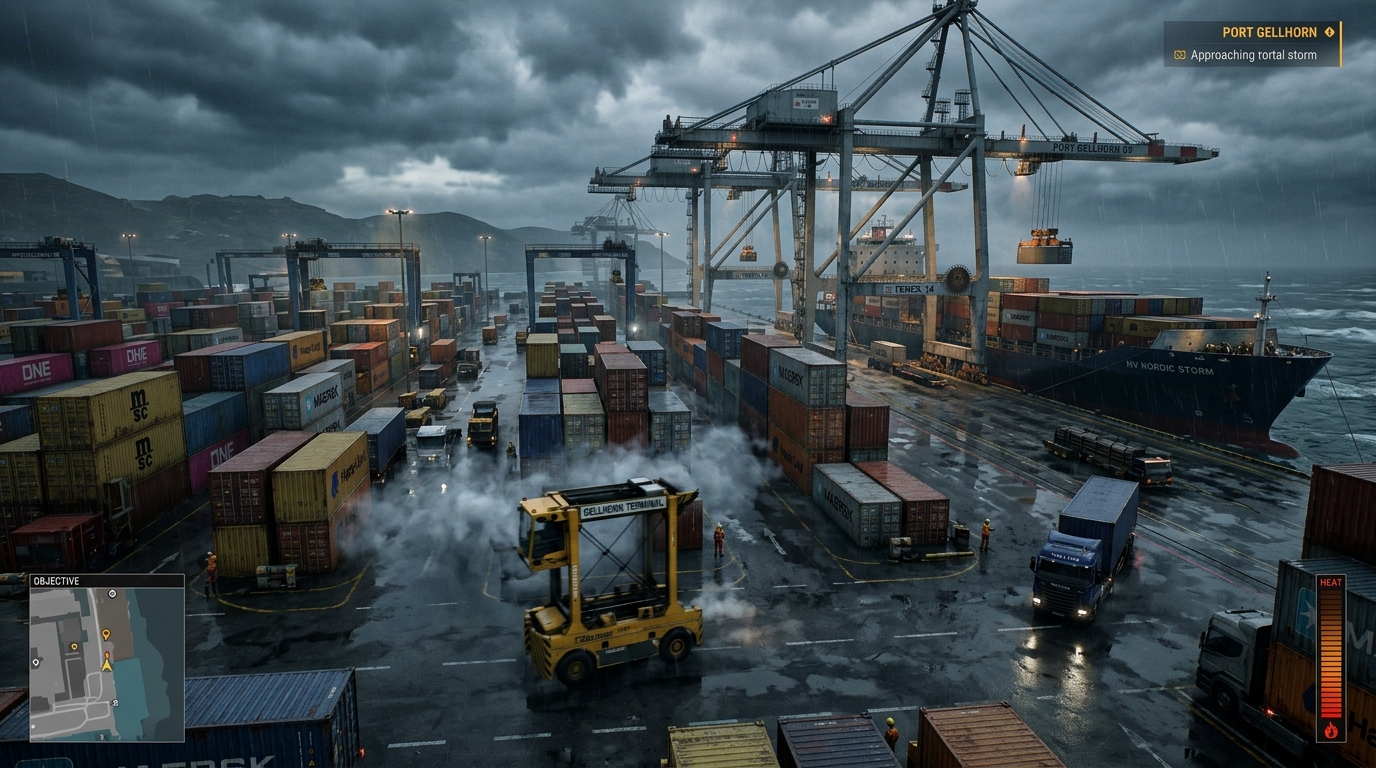
IN-ENGINE DIRECT-FEED TELEMETRY
RAGE 9 SPECIFICATION
GTA 6 Graphics Glossary: Key Engine & Visual Terms
Modern video games use lots of technical buzzwords: ray tracing, frame budgets, mesh shaders, upscaling, and more. If you’ve ever wondered what these terms actually mean for your gaming experience, this guide breaks down every key concept into plain, easy-to-understand English.
Here is your quick-reference glossary for all the major graphics terms used throughout GTA 6 discussions and analyses.
1. Ray Tracing & Lighting Systems
BVH (Bounding Volume Hierarchy)
A geometric acceleration tree structure stored in VRAM that organizes scene triangles into hierarchical geometric bounding boxes (typically Axis-Aligned Bounding Boxes or AABB). During ray traversal, the GPU’s fixed-function ray tracing hardware (such as RT Cores on NVIDIA Ada Lovelace or Ray Accelerators on AMD RDNA 2/3) tests ray intersections against large parent bounding boxes first, culling non-intersecting geometry branches before testing individual high-polygon primitive meshes. Efficient BVH management is the single most critical factor determining ray tracing CPU and VRAM overhead in dynamic open worlds.
RTGI (Ray-Traced Global Illumination)
The simulation of dynamic indirect lighting bounces in real time. When primary light rays strike a surface, photons scatter into the environment, illuminating adjacent surfaces with reflected color and luminance (color bleeding). Unlike legacy screen-space ambient occlusion (SSAO) or static baked lightmaps, RTGI calculates multi-bounce irradiance dynamically as the sun moves, weather shifts, or artificial light fixtures toggle.
Surfel Radiance Caching
A surface element (surfel) spatial caching technique that stores irradiance and radiance samples across a sparse, persistent world grid. Instead of casting hundreds of stochastic rays per pixel every frame, the renderer queries and interpolates cached surfels, drastically amortizing the compute budget while maintaining high temporal stability and zero light leaking in enclosed rooms.
Ambient Occlusion (RTAO)
The real-time calculation of contact shadows and ambient light attenuation in geometric crevices, corners, and overlapping foliage. RTAO casts short-range rays from surface normals to determine how much hemispherical sky light is blocked by nearby geometry, eliminating the floating-object artifacts common to screen-space ambient occlusion (SSAO) and Horizon-Based Ambient Occlusion (HBAO).
Specular Reflections vs. Diffuse Interreflection
- Specular Reflections: Coherent ray bounces that preserve image clarity across smooth, mirror-like surfaces such as polished chrome, vehicle lacquer, architectural glass, and calm water.
- Diffuse Interreflection: Incoherent, scattered ray bounces across rough, matte surfaces (concrete, asphalt, drywall, fabric) that distribute soft ambient illumination and subtle color tinting throughout an environment.
Denoising & Spatiotemporal Filtering
Raw real-time ray tracing typically casts only 0.25 to 1 ray per pixel due to strict 33.3ms or 16.6ms frame budgets, resulting in high-frequency Monte Carlo noise. Real-time denoisers (such as NVIDIA Real-Time Denoisers or custom spatial wavelet filters) filter noise across adjacent spatial pixels and accumulate samples across multiple temporal frames using motion vectors to generate smooth, artifact-free lighting.
2. Geometry & Memory Architecture
Mesh Shaders (Task & Mesh Pipeline)
A modern geometry rendering pipeline introduced in DirectX 12 Ultimate and Vulkan that replaces legacy fixed-function input assemblers, vertex shaders, hull shaders, and domain shaders. Mesh shaders allow developers to process geometry in small, GPU-thread-friendly clusters (“meshlets”) of roughly 64 to 128 vertices. This enables aggressive hardware-level frustum culling, dynamic Level of Detail (LOD) transitions, and sub-pixel triangle elimination before rasterization.
DirectStorage & Sampler Feedback
- DirectStorage: An I/O subsystem API that bypasses the CPU decompression bottleneck by routing compressed game assets (textures, geometry, animations) directly from high-speed NVMe PCIe SSDs into GPU VRAM via hardware decompression blocks.
- Sampler Feedback: A GPU hardware feature that records precisely which mipmap tiles of a high-resolution texture were actually sampled during rendering. This allows the streaming engine to load only the visible 64KB sub-tiles of a 4K texture into VRAM, reducing memory footprint by up to 60%.
Dynamic Level of Detail (LOD) & Discrete Meshes
The algorithmic scaling of 3D model complexity based on distance from the virtual camera. As vehicles, pedestrians, or buildings recede into the horizon, high-polygon meshes swap out for simplified proxy geometries to conserve vertex processing and draw call overhead.
VRAM Bandwidth & Unified Memory
- Unified Memory (Consoles): A single shared memory pool (e.g., 16 GB GDDR6 on PS5 and Xbox Series X) accessible simultaneously by both the CPU and GPU through a unified cache-coherent bus.
- Discrete VRAM (PC): Dedicated high-speed video memory (GDDR6X, GDDR7) situated on the graphics card, communicating with system RAM and CPU across the PCIe bus.
3. Image Reconstruction & Upscaling
┌────────────────────────────────────────────────────────┐
│               Image Reconstruction Stack               │
├───────────────────┬────────────────────────────────────┤
│ Spatial Scaling   │ Bilinear, Bicubic, AMD FSR 1.0     │
│ Temporal (TSR)    │ AMD FSR 2/3, Unreal TSR, TAAU      │
│ Neural / ML (NPU) │ Sony PSSR, NVIDIA DLSS 3.7, XeSS   │
└───────────────────┴────────────────────────────────────┘
PSSR (PlayStation Spectral Super Resolution)
Sony’s proprietary machine-learning-based temporal upscaling technology deployed exclusively on the PlayStation 5 Pro. Utilizing a custom hardware Neural Processing Unit (NPU) delivering approximately 300 TOPS of 8-bit machine learning compute, PSSR processes low-resolution internal render buffers (e.g., 1080p–1200p), motion vectors, and color history to reconstruct a sharp, temporally stable 4K image with minimal artifacting.
DLSS (Deep Learning Super Sampling)
NVIDIA’s AI-powered neural upscaling and frame synthesis suite:
- Super Resolution (DLSS 2/3.7): Tensor-core-accelerated spatial-temporal autoencoder that reconstructs high-resolution frames from lower input resolutions.
- Frame Generation (DLSS 3): Optical flow acceleration hardware generates entirely interpolated intermediate frames between traditionally rendered frames, effectively doubling perceived framerate on high-refresh displays.
- Ray Reconstruction (DLSS 3.5): Replaces hand-tuned real-time denoisers with an AI model trained on supercomputer render farms, generating sharper reflections and more accurate global illumination.
FSR (FidelityFX Super Resolution)
AMD’s open-source spatial and temporal reconstruction suite. Unlike DLSS and PSSR, FSR 2 and FSR 3 utilize non-machine-learning temporal accumulation algorithms designed to execute on standard asynchronous compute pipelines across AMD, NVIDIA, Intel, and console hardware.
Dynamic Resolution Scaling (DRS)
An internal render engine mechanism that dynamically adjusts the native horizontal and vertical pixel count of a frame on the fly to prevent frame-time spikes. When GPU load exceeds the frame budget (e.g., entering a dense crowd or heavy tropical storm), DRS lowers native resolution within a predefined bracket (e.g., 1440p down to 1080p), allowing the temporal upscaler to maintain a locked 30 FPS or 60 FPS output.
4. Hardware & Performance Metrics
| Metric | Target (30 FPS) | Target (60 FPS) | Primary Hardware Limiter |
|---|---|---|---|
| Frame Time Budget | 33.33 milliseconds | 16.67 milliseconds | CPU Main Thread / GPU Raster |
| Draw Call Budget | ~8,000 - 12,000 | ~4,000 - 6,000 | CPU Driver Overhead & API |
| BVH Build Time | 2.5 - 4.0 ms | 1.0 - 1.8 ms | CPU Simulation & GPU Compute |
| Raster Fill Rate | High (DRS Scaled) | Very High (Requires Upscaler) | GPU Render Output Units (ROPs) |
| VRAM Consumption | 10 - 12 GB | 12 - 16 GB | High-Res Textures & RT Buffers |
Frame Time Budget
The temporal duration available to compute, simulate, and draw a single video frame. At a target of 30 frames per second, the combined CPU game simulation thread and GPU rendering pipeline must complete within 33.33 ms. At 60 frames per second, that budget shrinks by 50% to 16.67 ms. If either the CPU or GPU exceeds this window, a dropped frame or frame-pacing hitch occurs.
CPU Simulation vs. GPU Render Bound
- CPU Bound: A performance state where the central processor cannot compute world physics, crowd AI routines, audio occlusion, animation rigs, and graphics API draw calls fast enough to feed the GPU. Lowering resolution does not improve framerate in CPU-bound scenarios.
- GPU Bound: A performance state where the graphics silicon cannot execute geometry vertex shaders, rasterization, pixel shading, and ray traversal within the frame budget. Lowering resolution or graphics settings directly restores performance.
Asynchronous Compute (Async Compute)
The simultaneous execution of graphics rendering queues and general-purpose compute shader queues across the GPU’s compute units. Async compute allows the engine to overlap physics simulation, ray tracing BVH building, and post-processing passes during underutilized rasterization bubbles.
Technical Summary & Further Reading
Mastery of these graphics systems is essential for dissecting the generational leap introduced by Grand Theft Auto VI. To explore how these individual systems function inside the game, consult our detailed architectural analyses:
- For console implementation and CPU limits, review Performance Mode vs. Quality Mode and PS5 Pro PSSR Analysis.
- For ray tracing architecture, read Hardware Ray Tracing in GTA 6 and Atmospheric Weather & Dynamic Volumetric Lighting.
- For PC hardware recommendations and settings, see PC System Requirements and PC Ray Tracing Performance Analysis.